Hot take: if a concrete contractor tells you the job is “just a pour,” you’re about to pay for someone else’s shortcuts.
Concrete work is logistics, chemistry, weather forecasting, crew choreography, paperwork, and then, sure, placing and finishing a material that will absolutely expose every mistake you made an hour earlier. A good concrete company doesn’t just deliver a slab. They manage a chain of decisions that starts before excavation and doesn’t end until the cure is protected, the test breaks are logged, and the tolerances are defensible.
One-line truth:
A pour is the middle of the project, not the project.
The project phases: messy in real life, but predictable if you know the sequence
Some people want a clean checklist. A solid concrete company project guide can help, but field reality is more like a braid: site prep tugs on schedule, schedule tugs on mix choice, mix choice changes finishing time, finishing time changes curing, and curing dictates when you can load the slab.
Still, the bones of a concrete project usually look like this:
– Site prep and access (subgrade, drainage, utilities, haul routes)
– Layout and elevation control (forms, lines, benchmarks, laser levels)
– Formwork + embeds (rebar, mesh, dowels, sleeves, anchor bolts)
– Pre-pour checks (subgrade moisture, reinforcement cover, safety plan)
– Batching + delivery timing (the part most people underestimate)
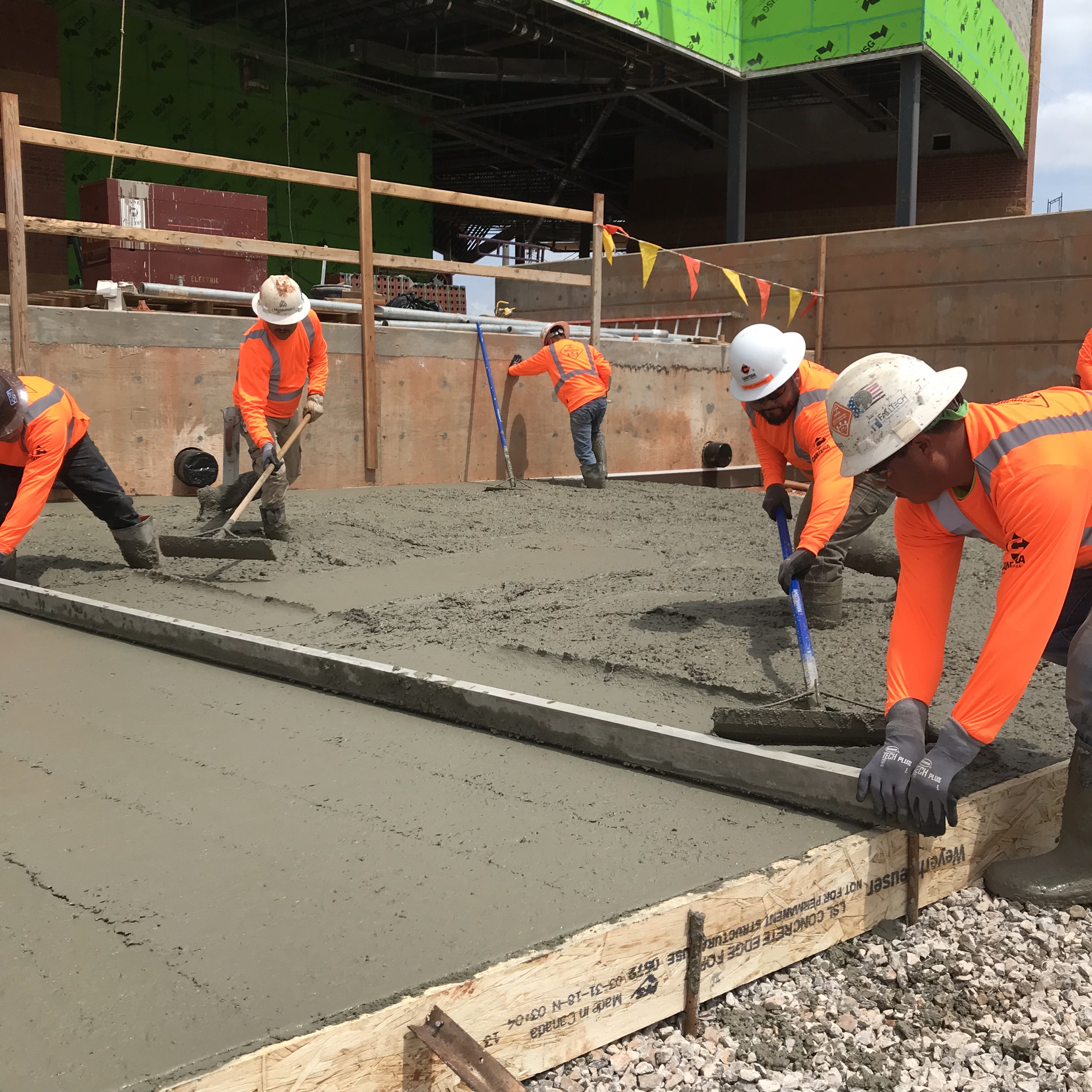
– Placement + consolidation (vibration, strike-off, segregation control)
– Finishing (flatness/levelness targets, edge work, texture decisions)
– Curing + protection (moisture + temperature management)
– Joints and crack strategy (cut timing matters more than people admit)
– QA documentation + handoff (test results, pour logs, as-builts)
Now, this won’t apply to everyone, but on commercial sites the “admin” portion can feel as heavy as the fieldwork, because inspectors, testing agencies, and owner standards don’t care that you “usually do it this way.”
Mix design: part engineering, part street smarts
Here’s the thing: “3,000 PSI concrete” is not a mix design. It’s a marketing label.
A concrete company (or their ready-mix partner) is thinking in terms of water-cement ratio, aggregate gradation, air content (if freeze-thaw is in play), set time, pumpability, finishability, and how the slab is actually going to behave when it dries and shrinks. That’s a lot of variables for a material people still call “mud.”
What gets decided (and sometimes fought over)
– Target strength and age: 28-day is common, but fast-track jobs care about 3-day/7-day performance
– Slump/workability: too stiff and crews overwork it; too wet and you risk strength/durability and finish issues
– SCMs like fly ash or slag: great for durability and heat control, sometimes a headache for set time in cold weather
– Admixtures: water reducers, accelerators/retarders, fibers (each with trade-offs)
In my experience, the best crews don’t just “order concrete.” They order concrete for the hour it will be placed, because temperature, wind, sun, and delivery spacing all change how that mix behaves.
A quick stat for context: ready-mix trucks in the U.S. commonly operate around a 9, 11 yard capacity range, and dispatch timing can make or break a slab-sized pour window. The scale of logistics here is huge: the U.S. produced about 92 million metric tons of cement in 2023 (USGS, Mineral Commodity Summaries: Cement). That doesn’t happen without an industrial-grade supply chain, and your project is riding on it.
Scheduling is a concrete company’s quiet superpower
You can have a perfect form, perfect steel, and perfect crew, and still get wrecked by late trucks or a surprise rain band.
A capable concrete company builds a schedule that accounts for the parts nobody wants to talk about:
– permit/inspection lead times
– subgrade acceptance (proof-roll issues are real)
– weather windows (wind can kill finishing; cold can kill set)
– manpower stacking (finishers don’t teleport)
– coordination with other trades (embeds, sleeves, sawcut access)
A scheduling rhythm that actually works
Weekly status updates beat heroic day-of scrambling. I’ve seen projects “save time” by skipping coordination meetings, then lose two weeks to rework and finger-pointing. Look, meetings can be painful, but re-pours are worse.
Site prep: unglamorous, expensive to get wrong
If the subgrade is wrong, concrete doesn’t magically fix it. It just freezes the problem in place.
Prep includes compaction, grading, drainage paths, and confirming utilities aren’t where they shouldn’t be. It also includes the boring-but-critical safety setup: access routes, pump locations, washout planning, and who’s controlling traffic if trucks are backing into a tight site.
Two-sentence section, because it deserves it:
Bad prep makes good finishing impossible.
And the slab will still get blamed.
Formwork and layout: where “close enough” becomes a lawsuit
Formwork is geometry under pressure. Literally.
The company is checking line, elevation, squareness, stake integrity, and bracing, then coordinating reinforcement placement so cover is correct and chairs don’t collapse during the pour. Anchor bolts and embeds have to be where the next trade expects them, steel columns don’t “kind of” fit.
Opinionated but true: I’d rather see a contractor obsess over layout than brag about how fast they pour.
Placement + consolidation: the pour is controlled chaos
A pour is loud, fast, and unforgiving. This is where experience shows.
The crew is watching for:
– segregation (too much free-fall, too wet, too aggressive placement)
– cold joints (timing gaps between loads)
– over-vibration (yes, that’s a thing, can drive aggregate down and weaken the surface zone)
– edge stability (forms blow out when people get casual)
And then finishing starts, not when it’s convenient, but when the concrete says it’s time.
Finishing: it’s not “make it smooth,” it’s “hit the spec”
Finishing decisions depend on use. Warehouse slab? You might be chasing flatness/levelness numbers. Exterior walk? You’ll want traction and drainage. Decorative? Now you’re balancing aesthetics with durability.
Also: finish timing is a chess match with evaporation. Too early and you seal bleed water (hello blistering). Too late and you burn labor hours fighting a slab that’s already tightened up.
Curing: the phase clients don’t see, and contractors can’t fake
Curing isn’t optional. It’s strength, shrinkage control, surface durability, and long-term performance wrapped into one jobsite routine.
A decent curing plan answers:
– When does curing start (immediately after finishing, usually)?
– Which method fits the conditions: wet cure, curing compound, plastic, blankets, fogging?
– How will temperature be controlled in heat/cold?
– Who documents it?
A one-line emphasis, because people still ignore this:
Concrete doesn’t “dry.” It hydrates.
Lose moisture too fast and the surface pays for it, crazing, dusting, early cracking, weaker top paste. I’ve seen beautiful slabs get wrecked in 48 hours because nobody protected them from wind and sun (and everyone acted surprised).
Testing and QA: proof beats confidence
Testing isn’t about “catching” the contractor. It’s about removing argument later.
Common field and lab checks include:
– Slump (workability consistency)
– Air content (critical for freeze-thaw durability)
– Concrete temperature (affects set and early strength)
– Compressive strength cylinders (7/28-day breaks are typical)
Non-destructive tools (like rebound hammers) can help spot relative variation, but they’re not a magic truth machine. When the spec matters, strength breaks and documentation matter more.
Good QA looks like disciplined logging: batch tickets tied to pour locations, weather notes, start/stop times, curing method, sawcut times, issues encountered, and corrective actions taken. It’s not glamorous. It is powerful.
Joints and crack control: you’re not preventing cracks, you’re choosing where they go
Concrete cracks. Anyone promising “crack-free forever” is selling vibes, not workmanship.
So a concrete company plans crack control through:
– joint layout (spacing aligned with slab geometry and restraints)
– reinforcement strategy (helps hold cracks tight, not eliminate them)
– sawcut timing (often the difference between clean joints and random cracking)
If you want one practical litmus test: ask how they decide when to start sawcutting. If the answer is “when we get around to it,” that’s a problem.
Budgeting + changes: where projects either stay sane or go sideways
Concrete work is sensitive to small scope changes. Add a thickened edge, move a trench drain, change finish class, accelerate schedule, cost ripples out.
A professional company runs a change process that’s boring on purpose:
– written request
– cost/time impact
– approval
– updated schedule and pour plan
– revised documentation trail
Itemized invoices should map to scope line items. If you can’t tell what you paid for, you’ll fight about it later.
Look, I’m opinionated here: vague pricing is a red flag. Concrete is measurable, square footage, thickness, yards, steel quantity, finish type, cure method. You can price it transparently.
Picking a concrete team: the questions that expose competence fast
Ask questions that force specifics, not rehearsed confidence.
Crew and quality
– Who is the foreman on pour day, and how many similar pours have they run?
– What’s your plan for hot/cold weather placement?
– How do you prevent cold joints on a large slab?
QA and documentation
– What tests are you running, and who pays for failed breaks/retests?
– How do you track batch tickets to pour locations?
– Show me a sample pour report from a recent job (names can be redacted).
Schedule realism
– What’s your typical truck spacing and contingency if dispatch slips?
– How do you coordinate sawcutting access with other trades?
Safety and site control
– Where’s washout going?
– Who controls truck traffic and pump setup?
– What’s your near-miss reporting practice?
A solid outfit answers calmly, with details, and doesn’t act offended by basic accountability. The shaky ones get defensive or vague.
Concrete companies don’t just place material. They manage risk, technical risk, schedule risk, and human risk, while trying to make a permanent product out of a temporary moment. That’s the job. The pour is just the loudest part.
 You don’t buy a mild hyperbaric chamber on a whim. You buy it because you’ve done the research, you understand the potential benefits for recovery, focus, or cellular health, and you want a device that actually delivers. That’s where the rubber meets the road. Because the market is flooded with options, but not all of them are built to the same standard. The VitaOxy Mild Hyperbaric Chamber stands apart for one simple reason: it comes with CE certification and a warranty that backs up the engineering. That’s not just marketing fluff. That’s a promise.